


Horse Self-Carriage, Simplified: How to Develop Balance and Responsiveness

Updated:
September 18, 2026By Lindsay Grice, Equestrian Canada coach and judge
I tend to think of self-carriage like cruise control. A horse in self-carriage remains on the path, in the gait, in the tempo, and in the frame his rider requested, for several strides without being held there.
Picture this: Your horse is attentive and yet relaxed. His ears are forward yet checking back to you with each aid you deliver. He’s light to your signals, responding readily. Communication feels conversational rather than a lecture. And the ride feels buoyant. That’s self-carriage.
Picture this: A dressage competitor rides with an elastic arm and only a neutral feel of her horse’s lips. A reining competitor lopes a fast circle, her horse “looking through the bridle,” his head and neck aligned within the corridor of her reins, his shoulders and haunches following the arc of the circle. That’s self-carriage.

This horse is stepping outside the corridor through the rider’s outside rein and leg… and out of alignment. Photo courtesy of Lindsay Grice
Picture this: While lunged, a horse trots at a consistent distance from his handler with no cutting in or bulging out, and the lunge line relaxed. No whip cracking is needed to maintain the tempo. By simply noting an elevated whip and hearing a quiet kiss, the horse lifts into a balanced canter. That’s self-carriage.
Like a self-propelled lawnmower or an airport moving walkway, riding a horse in self-carriage takes less effort.

This horse is longitudinally balanced with his nose on the line of travel, front and hind feet straddling the line. Photo courtesy of Lindsay Grice
Related: How to Ride Your Horse in Circles
The Box Principle
Self-carriage develops as a horse discovers, by trial and error, the box that defines his rider’s limits for the line of travel, speed, and shape at each moment in the ride. So, when a horse I’m riding deviates from the line, speed, or shape I have in mind, he’ll find the boundaries of my aids. I’ll simply reset him and carry on. For example, if he accelerates, he’ll find rein contact. If he cuts to the inside of a corner, he’ll find my inside leg. If his rhythm becomes flat, he’ll feel my leg pressure sending him forward again. Most importantly, my horse will reliably find release within the borders of my box. It’s my responsibility to make the box a place the horse wants to be.
Negative reinforcement is an important concept in training horses. We take away the pressure (negative) to reward (reinforce) the desired response.

This horse won’t learn to find freedom in the box’s limits with his too-snug martingale’s continual pressure. Photo courtesy of Lindsay Grice
Support: I’ve never been a fan of the term “support” when referring to our riding aids. Horses don’t learn from being held in place. For example, in a canter transition, preventing your horse from drifting in by supporting with your inside leg or “holding his shoulder up” with an indirect rein will not inspire him to carry his own balance. Instead, make a timely course correction on his first wayward step, then leave him alone.

Horses don’t learn from being held in place but rather from the release after responding to pressure. Photo courtesy of Lindsay Grice
Balance: This is a term frequently seen on dressage score sheets. What is “balanced”? When your horse has his weight equally distributed on his outside and inside limbs, whether traveling straight or curved, he’s balanced laterally. Longitudinally, when your horse shifts balance from his forehand to his hind end, he’s “lighter.” A horse moves, jumps, stops, and makes transitions better when balanced.
A horse holding its own balance without support is in better mental balance. Horses fare better when not held in place.
Realistically, some horses, depending on their conformation, need more adjustments to hold themselves in balance — just as I must accept that, despite excellent instruction, I simply don’t have the conformation to be a ballet dancer!
Define your box: Have a clear picture of what you expect in each section of your ride or each segment of your pattern, course, or test. Nothing can mess with a horse’s mind more than indistinct boundaries.
Where exactly is my line of approach to this trail obstacle? What degree of bend do I envision in this lateral movement?
What length of canter stride do I need?
Does this call for a collected or a longer, lower outline?
As in human relationships, insecurity and resentment arise when expectations shift or aren’t well communicated. Horses thrive on predictability.
Related: Mounted Exercises to Improve a Horse Rider's Seat and Effectiveness
Communicate clearly: If you’ve ever attended a lecture with a mumbling professor, you can relate to a horse’s predicament if he can’t decipher instructions from his rider’s legs or hands.
An important part of your horse’s emotional balance is understanding that specific signals call for specific responses. So, savvy riders are intentional about their communication.
I often ask riders at my clinics: “Describe the cue you use for _________.” It usually takes several follow-up prompts before they clarify the cue’s precise location, intensity, and method of application.
A balanced rider position and a secure yet flexible core are the base from which to operate. It takes focused practice to deliver your aids in the same manner and location every time.
However, over-practicing can sabotage self-carriage. For example, loping lap after lap can sap your horse’s energy and physical ability to carry himself well.
Back of your box: If you stop working so hard — pushing and clucking — will your horse fizzle out? Who’s doing most of the work? Self-carriage means not babysitting your horse with nagging aids.
I coach riders to aim for the following clear progression in retraining their “go”:
- First, make sure your horse understands the basic go-forward response: your leg pressure, distinctly applied at the girth, means accelerate.
- Next, expect your horse to respond from one light aid.
- Next, the horse carries himself forward for multiple strides from that single light aid.
Front of your box: Does your horse feel speedier than you’d like? Does he seem to brace against your rein aids, or worse, even build speed the more you hold on? Let’s clarify our “slow down” signal.
From the base of a stable core, I close my hands on the reins, close my elbows, and limit the flow of all my joints until my horse offers the answer I am asking for: he shortens his stride. I respond by relaxing the reins and resume my flow with his stride... until I sense the speed beginning to build. I may only relax the reins for a stride or two at first, but with repetition, the horse will find the sweet spot.
Sides of the box: Is your horse on track, not cutting in or shifting out off your line? Self-carriage is when your horse stays in alignment for several strides, lightly balanced in the chute between your hand and leg. When out of alignment, horses swap leads, jump in poor form, or break gait. Self-carriage means not holding your horse out on the rail with your outside rein or supporting your horse’s bend with an inside elevated rein. Instead, if your horse steps a front foot outside the margins of your chute, your goal is to simply restore that foot back on track with a press from your calf at the girth.
Related: Resolving Bit Resistance in Your Horse
Setting Up the Limits
Ask: Our goal is always the lightest version of each aid, clearly applied — a conversational relationship between horse and human.
Amplify: Horses may tend to lean on boundaries without sufficient motivation not to. Horses soon habituate to rider aids and eventually become dull. Or worse, they develop behaviour problems such as resenting the limits, rooting on the reins, becoming sullen, or kicking out.
After you’ve made a reasonable, light cue, dial up the volume until you get a reaction without an overreaction. How you go up the scale may depend on your horse’s temperament. A sensitive horse requires careful crescendo. A laid-back horse might benefit from a whip tap or spur lift to motivate a response.

A laid-back horse might benefit from a whip tap to motivate a response to move forward off the back of the box. Photo courtesy of Lindsay Grice
Reward: Constant pressure is confusing to a horse. If he could speak, he might ask What DO you want me to do? When a horse’s attempt isn’t reinforced with freedom, he’ll be discouraged from trying to find the right answer.

When a horse’s attempt is not reinforced with freedom, he may get discouraged from trying to find the right answer. Photo courtesy of Lindsay Grice
Drop your heel, soften your arms, and relax through your joints to communicate yes to your horse. In teaching any new concept, I try to exaggerate my yes. You’d see me congratulate my horse’s effort with a brief slackening in my rein travelling right through my arms to elastic elbows, supple wrists, and soft fingers.
In fact, some dressage tests call for a test of self-carriage by showing a clear release of the rein for several strides — a good picture to keep in mind.

This rider holds firmly to slow her horse, setting the front of the tempo box (top)…AND …then softens her hand when her horse settles back into the tempo she desires (bottom). Photos courtesy of Lindsay Grice
Related: Steffen Peters Dressage Clinic: Teaching Moments in Self-Carriage
Self-Carriage in Transitions
Balanced transitions are recognized by:
No flee: Tension stirs up a horse’s flight instinct to rush out the “front door” into the next gait and land beyond your desired pace.
No brace: No resistance to your aids, such as gapping his mouth or tossing his head. No sticking on your leg aids, such as a trotting drumroll into every canter transition.
No cutting to the inside or fishtailing to the outside: As training progresses, so should your expectations that your horse will stay mindful of the box’s borders during transitions. Here are a few unhelpful habits I often point out to riders who are not aware they’re practicing them:
- Habitually transitioning to canter on a circle or at a corner. Though helpful for a very green horse, a habit of curving into a canter promotes a habit of dropping the inside shoulder on canter transitions and lead changes.
- Curving into the middle of the ring with each downward transition from canter to walk, perhaps as a way of letting off the pressure and thanking their horse for the nice effort. Taking away the pressure needn’t mean taking away the guiderails of balanced transition alignment.
- Trotting into lope transitions well beyond the green horse stage.
Self-Carriage Begins on the Ground
If self-carriage is about developing “stay” in your horse, let’s not limit the concept to when the horse is under saddle! Teach your horse simple things like:
- Park in place
- Lead, on your own track, beside my shoulder
- Wait still while I mount

Developing self-carriage in your horse begins on the ground. I’m defining the boundaries on the mat with a light whip tap on the neck or chest. Photo courtesy of Lindsay Grice
When aware of your expectations, your horse is guaranteed to be more enjoyable to be around. And since horses thrive in clarity, he’ll have the peace of predictability.
What shape of box are you setting around your horse when you lead him? Is your horse sometimes allowed to walk off before asked, to circle around you, rub on you, or dive down for grass, while at other times he’s reined back or yanked for doing those things? As I often say to my students, there’s no “sometimes” in training horses!

Help your horse want to stay while mounting. This rider mounts smoothly and with soft reins, not holding her horse in place. Photo courtesy of Lindsay Grice
Can your horse find freedom within the boundaries? Take care not to make a hurrying horse stay by physically holding him by your side or even letting the weight of your arm rest on the lead shank. He should figure out by trial and error that the box by your side is the sweet, safe spot for him to be.
Don’t hold yer horses! Holding on is the undoing of self-carriage. Instead, try taking off the training wheels under saddle or on the ground and see if your horse can remain in balance. Self-carriage is a horse who happily stays within the borderlines of his rider’s relaxed aids.
Related: Nail the Correct Canter Lead
Related: Equitation Essentials - The Hows and Whys of a Winning Riding Position
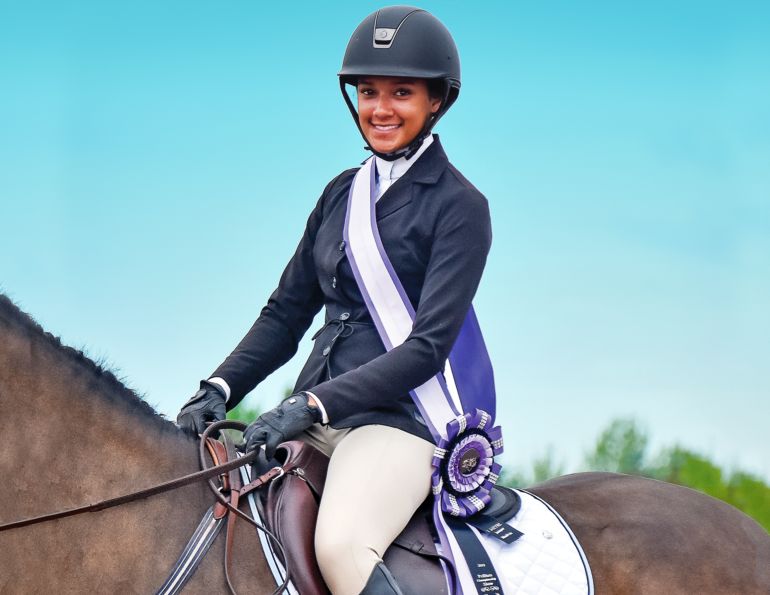
Main Photo courtesy of Lindsay Grice
Blogs & Podcasts

Advertisement

Related Articles


Advertisement

Featured Stories



Advertisement
